Episode Transcript
[00:00:00] Speaker A: I would read anything that I could on so many subjects, and that previously was not me at all.
And I can actually look back and see how God used that because I didn't want to have a kind of what atheists would define as faith is what we would call blind faith, which is not the faith of the scriptures. It's not the faith of the Bible.
[00:00:33] Speaker B: Hello and welcome to X Skeptic, where we feature unlikely stories of belief. We have conversations with former skeptics and atheists who came to believe in God and Christianity, and I'm your host, Jana Harmon. If you find our conversations meaningful, I'd love for you to follow and subscribe or share this episode with someone who may be also asking similar questions like the ones we address here. What would it take for someone who had both emotional and intellectual reasons to reject God to reconsider?
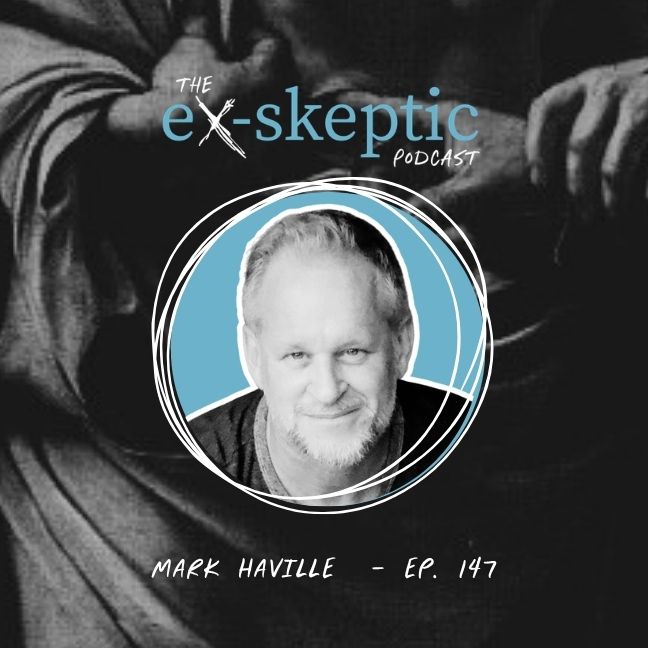
My guest today, Mark Haville, grew up in an abusive home with no religious foundation and every reason, both personal and scientific, to assume that God did not exist.
Suffering shaped his early life. Evolution shaped his assumptions.
Faith seemed unnecessary at best, irrational at worst. And yet something shifted.
In this conversation, we explore how belief engages more than just evidence, how the mind, will and emotions all play a role in what we ultimately accept as true. We also wrestle with science, suffering, sovereignty and forgiveness, and consider whether the evidence and the struggles of human life make better sense in light of a living God. We cover a lot and I'm so glad you're here.
Welcome to X Skeptic. Mark, it's great to have you with me today.
[00:01:58] Speaker A: Good morning Jayna. Good to see you.
[00:02:00] Speaker B: It's good to see you as well. Let's get started by you telling us a little bit about the kind of work you've done with the film industry, what you have your hands in now, a little bit about who you are.
[00:02:12] Speaker A: Sure. Well, I'm based in out of Nashville with my wife Brenda and we run an organization called Timeless Life Ministries which is a not for profit.
So we have our hands in various things as the Lord leads effectively in terms of distribution, production, screenwriting, things like that.
So typically we'll take programs that people have produced and try to get as wide a distribution for them as possible, sort of Amazon prime or Tubi TV or TV networks and get those programs out there. So we handle everything that we can that is biblically based, from movies to documentaries to stand up comedy.
So at the moment we are, excuse me, trying to fund a couple of movies. One you see behind me there, the tide can turn, which would be the first ever Musical drama feature film for Christians and another movie called 22 Kids and Counting, which is a true story set in the 1960s of a family that ended up with about 25 children in their home, eight of which were their own and the rest they took in and took care of.
So yeah, got a couple of projects like that that we are trying to bring to life.
[00:03:28] Speaker B: Yeah, wonderful. Well, let's get into your story.
Let's start with your background.
You have a very non Nashville dialect. So yeah, let's start back to where you were born and tell us about that. Tell us about the home in which you were born, whether or not religion or faith had anything to do with. With your life there.
[00:03:51] Speaker A: Well, there's a great line in a song, I think it might be a Zach Williams song where he says, you know, everyone's got a broken twisted story they can tell. So I'm. I'm pretty high on that list. So unfortunately, yeah, I was well born in obviously in the uk, as most people would guess from from my accent.
Lived and raised mostly around the north of London and the home counties surrounding Lond.
I had three, four mothers by the time I was six or seven years old with my father's particular lifestyle.
His first wife had passed away and had a son from her.
My mother also had a daughter from a previous husband who had also passed away and married my father. And there was me. So that made three.
And then she divorced and her girlfriend, another baby, she took off and then married again. So it was that kind of. So yeah, there was no religion in our home and it was. It was a hard childhood. It was definitely abusive, hard upbringing.
And in fact, to date I am still the of. There's. I actually only have, I think three relatives that are older than me that are still alive from my side of the family.
I have one or two. I have some couple of younger sisters, half sisters who, you know, alive still and an older sister that I cannot find.
And yeah, there was certainly no religion in our family, that's for sure.
And in fact, I am still the only Christian in my family from that family. Not from my, you know, previous marriage or children, but certainly from that side of the family. I'm still the only one. So yeah, interesting how that kind of came about, I guess.
[00:05:57] Speaker B: So in the UK system, I know that there's some religious education in school that may have been your only touch point.
Did you learn about God in school? Was there any kind of influence outside of your home that might have give some suggestion about who God is or what religion Is or who Jesus is or was that just a.
Something completely irrelevant and not available to you?
[00:06:23] Speaker A: Well, I mean, back in the sort of, you know, late 60s, early 70s, when I went to school, certainly we did have what was called re religious education, but that included other, you know, they were just required to teach, you know, the, the main faiths of the world and some of the, the key points, you know, the five pillars of Islam and you know, the Lord's Prayer or something like this. But it was certainly, you know, his education. It wasn't supposed to be evangelistic or anything. I mean, you might have an RE teacher that was a Christian. That was always possible.
So yeah, very limited exposure to anything religious until I got into my late teens and not too long after my grandmother passed away who actually raised me at one point for some time. So yeah, was nothing from the family for sure. Not really anything around and didn't really have any real concept of who God was. And of course they, in school you might get a little bit of religious education, but you've got a lot of scientific education which of course was rooted in atheism.
[00:07:29] Speaker B: So did you grow up believing that narrative?
[00:07:33] Speaker A: I grew up believing in the evolution. That's what I'd been taught, you know, that we had a common ancestor with apes and monkeys.
And of course that would make you doubt the Bible. Certainly if you were starting from Genesis, then you'd be like, well, okay, so when I thought the earth was millions of years old or the universe was billions of years old, and I thought we all came from a single cell at some point back in the past. So, you know, that was what we had all been taught. Certainly in the west. That's the common teaching.
[00:08:04] Speaker B: So that was kind of an open shut case, I guess for you. It didn't cause any curiosity for you, you just accepted that's just the way that things were.
[00:08:14] Speaker A: For sure. Yeah, for sure, yeah.
[00:08:15] Speaker B: Now, would you have considered yourself an atheist?
[00:08:18] Speaker A: I think I just never really thought about it that much.
It, you know, I would be more atheistic in my thinking than, but not active. I wasn't sort of, you know, the hardcore atheist that you would meet today.
Because it just wasn't something I really thought about. You know, life was tough, had always been tough.
I mean, I left home the first time at age 15, which is way too young to leave home and get into trouble and try and fend for yourself, you know, because of an abusive home environment.
So God to me was not something I ever really, really thought about. Could even be real to be Honest, when you look at what life had kind of dealt you.
[00:09:03] Speaker B: Yeah. So both from an intellectual perspective, scientifically there's no God and from an experiential perspective, how could there be a God? I mean life is.
And especially in your situation, really horrible circumstances, I can see where it would be hard to believe. So you left home at 15, talked with us about your life at that
[00:09:23] Speaker A: point, quickly spiraling into a life of crime actually.
I mean, you know, you've got to kind of still to eat when you're 15 and can't work and just kind of a little bit on the streets, you know. So I think were it not for what the British system called a short sharp shock, which is when the magistrate says, okay, I've seen you three times now in the last six months, so we're just going to just not give you bail and just leave you in jail for a month or two and hopefully that'll show you up. Which did work actually. So I thought, well, stealing food from a shop does seem to be a bad idea. I think I might not do this anymore. So.
And then not very long after that I sort of. When I reached 18, 19 for the first time, I had an experience with someone who was a Christian who obviously I thought was completely crazy.
And I did. I mean I met for the first time a guy who was very evangelistic and trying to buy a second hand tv. I'm living in this little apartment above a bookie's shop as we would call it. You know, a place where you can bet money on the horses or the boxing or something.
And the owner of the bedding shop had this place he rented out above and I was living there and next door to him was a fella that was selling secondhand refrigerators and TVs. And you know, so they are 18, 19, no money and. But he was this kind of retired sergeant major who, you know, if you went and bought something from me, it came with a prayer, you know, you had to let him pray for you. He was this very forceful, you know, real character, like something from the movies, you know. Right, I've got to pray for you. Come sit down over here. You know, sort of, it kind of reminds me of the. I think it was, I can't remember if it was too Chitty Bang Banger. This is going to sing that sings that great song with a little bit of luck. He was that kind of sort of character. All right, come over here, sit down, we're going to pray for you, you know. And, and he says, well, anything you're scared of. Let's pray for that. And so I did. I had this kind of weird dream that I used to have every once in a while.
And then when he prayed for me, and I thought, this guy's nuts. You know, he's absolutely nuts.
And I remember sort of going back to the apartment that night and laying in bed, trying to conjure up the memories of the images of this dream that I used to have. And I couldn't.
And I'm like, that's really, really odd.
[00:11:45] Speaker B: Was it a. Was it a bad dream that you were having?
[00:11:48] Speaker A: Yes, it was. It was a bad dream. It was a sort of like, I had this dream where. Well, I could get the images, but I couldn't get the feeling, if that makes more sense. So obviously I hadn't had my memory erased. You know, I'd had this dream previously in the past where it was like I was in a darkness, but I was underground.
And I was aware that it was like a children's playground on the surface, and you could hear the children playing on the swing sets and different things, yet I couldn't move and I couldn't speak, but I was conscious in this sort of darkness. It was very weird.
And of course, I had this horrible sensation that went with it.
So when I tried to recall, I could still kind of see the. The image in my mind, but I didn't have the feelings anymore. I couldn't get that horrible, fearful feeling. I thought, that's weird. That's very, very strange. There must be something to this. So I went to church. I thought, well, okay.
And I actually was baptized the first time I went to church, because in my way of thinking, I was like, well, if there is a God. And they were explaining this and they made sure they preached the gospel because there was this strange new face sitting there.
Then I thought to myself, well, he's got some rules that makes sense, you know, so, you know, repentance seems the obvious thing. You know, if he made us and he's in charge, then I've definitely. I already knew. I. I didn't need explaining to me that I was a sinner. I mean, that was. You know, that was a given. So, yeah, so that was how I first came to faith. And it might have been, you know, certainly somewhat of a weak faith. And I think with all folks, all of us, when we get saved, you know, there's. There's a journey process which can go on for a very long time, maybe continuously as we believe as well. We come up against new questions and New doubts and new fears and challenges.
And that certain certainly happened.
[00:13:44] Speaker B: Well, I, I am still a little bit confused because this man prayed over you. You thought he was weird, you thought he was crazy.
And then you're telling me you went to church because, well, you. You're telling me that you had a dream that you didn't have the fear associated with it, and that was convincing enough for you to, to make you wonder if his prayer had had some effect on your life, is that you were putting two and two together.
Do you remember what his.
Do you remember what he prayed over you or for you?
[00:14:16] Speaker A: I don't. No, I don't. But I mean, he was very enthusia, very enthusiastic about it. I mean, he might have been somewhat Pentecostal, but.
And I remember that he was like, oh, do you. He sort of. I'm sitting down and he's got his hands over my head. I remember that part. And he was like, did you feel that? He said, I felt a heat. And then he said, I felt something, you know, as I was praying for you, he. He was absolutely 100 convinced that, you know, in what he was saying and doing that something was happening.
And yes, as you say, it was enough for me to think, huh, something absolutely definitely happened.
It wasn't subjective. It wasn't. Because I wasn't really into any of this. I wasn't necessarily open to anything religious at all. I hadn't given it a second thought.
And I guess over a period of some days after that, I was thinking about it and then, you know, we lived next door to where his shop was, so, you know, I couldn't walk by without him seeing and sort of knocking on the window and, hey, come in and talk to me. Let's have a cup of tea, or, you know, and so that's where it went. So eventually I did go to church. I don't know what the time frame was. You know, it's 40 years ago now, but.
[00:15:27] Speaker B: Right. So he called so you would have a cup of tea with him and would he talk about spiritual things?
[00:15:32] Speaker A: Oh, yeah, he would talk.
[00:15:36] Speaker B: And I guess you shared with him what happened with your dream. And. Yeah, and he was. He was then convinced this maybe something happened as well through the prayer. So at that point, it sounds like through this conversation, through your neighbor, that you became more open to the possibility of there is something here, maybe Christianity or belief or God isn't as weird or strange or distant perhaps, and you were willing to give it a chance.
[00:16:03] Speaker A: Right. And the first thing, and the interesting thing that. And Some of the things, I guess, must have followed each other fairly rapidly. But after I was baptized and I wouldn't even look back, and if I'm being 100% honest and say I was 100% convinced, I 100% believed and was, you know, as repentant as anybody could possibly be, then there was quite probably a part of me that was like, oh, let's give this a try sort of thing, you know.
But after.
After I was baptized and had been to church for the first time, there was this change.
Ah, now that was a big deal because, you know, I cursed like a sailor.
Sailors always get the blame. But anyway, I cursed, you know, so.
And I just didn't.
And certain ways of thinking and thoughts, feelings, whatever you want to call it, were just different, you know, So I knew something had absolutely happened. And my girlfriend at the time, I'm living with this girl, you know, we're not married, and she was like, oh, boy, you are different.
She knew something had changed as well.
So, you know, the pastor of the church began talking, began talking with me. You know, I'd go and sit and talk with him, and he said, well, you know, you can't live with this. Can't be living with this girl.
I mean, one of you's got to move out or. Or you've got to get married, you know.
So we ended up getting married a few years, a few weeks later, literally.
And, you know, the. They. All the church folks came together. We didn't have anybody to support us from, certainly from my side of the family. And then one. One lady would make a wedding cake and another lady would make fried chicken, and they painted the church, and we were the first person to get married in that church building. We were like, on the wedding certificate, we were like, 001, you know, the first.
First one ever, so to speak.
So, yeah, so that's how that happened.
[00:18:13] Speaker B: So based upon this experience, you entered into church, which you'd never stepped into. You heard what they call the gospel. You'd heard that you were a sinner and that Jesus came to save you and absolve you of your sins.
So you believed. I mean, there was this. There was this intuitive belief that this is true, this is real, something happened.
It's worth believing. So despite the fact that that of your complete history of a God who didn't seem to be there, particularly in your childhood growing up, and all of a sudden he showed up in your life in such a tangible way that was convincing enough for you to go, this is worth believing, maybe There is a God.
And you were seeing these tangible changes in your life.
[00:19:02] Speaker A: Yeah, I mean, I did. And then one of those big changes was I just suddenly started reading everything and I mean everything. I would read anything that I, that I could on so many subjects and that previously was, was not me at all.
And I can actually look back and see how God used that because I didn't want to have a kind of what, what atheists would, would define as faith is what we would call blind faith, which is not the faith of the, of the scriptures, it's not the faith of the Bible. In fact, you know, we could make a stronger case for atheism being blind faith because they believe that, you know, in the beginning there was nothing, and then nothing exploded and became something and something became everything. And, and some of the everything can actually think as well and write books about why it's all meaningless.
So, you know, there's that. And I didn't, I didn't want to have that kind of faith. I wanted to know that for sure that what I was believing fitted everything else.
And so I just read everything I could lay my eyes on.
And eventually that served me well because, you know, I don't think, even though I've had some very intense periods of suffering at some points as a believer, much of which I caused myself, you know, but nevertheless, I've never been at a place where I didn't want God or I didn't believe that God existed anymore, or he couldn't exist because I'm going through this terrible time.
I just couldn't. I mean, I certainly have periods in my life as a Christian where I've been backslidden and fallen away, but never hated God, never wanted to run away from God.
So, yeah, that was a big change and was very helpful in many ways.
[00:20:58] Speaker B: Let's, let's talk about both of those things. Both how you perceive a God of love and goodness in light of your.
Not only your childhood, but also the sufferings in your adult life as well. As I want to explore a little bit more about your intellectual journeying and how you feel like that supports the Christian worldview. Let's start with your how you reconcile, because that is a big question, isn't it? How can there be a good and loving God in the light of my circumstances? That's certainly what you thought and felt as a child growing up without God. So as a Christian, looking back and trying to reconcile that extremely difficult issue, how do you make sense of that? How would you explain that now as well? On the Other side?
[00:21:46] Speaker A: Yes, sure. I mean 2013, I moved from the UK to Texas and I was in, in Texas for seven, over seven years and then went through, unfortunately went through a divorce, an extremely traumatic period of time for about 15 months where in the same 15 months I had lost, you know, my home, most of my income, a marriage of 36 years, my, I had three friends that were killed, three more that died, dog died, mother died. This all happened in 15 months.
So I, you know, what people would call a breakdown. I probably had three of those during that over a two year period. And I cried every day for two years, almost entirely every day, for give or take five or six weeks.
Now again, I would say there's three types of sin in the world.
There's a sin that we commit, there's a sin that's committed against us and there's a sin that is societal or around us.
And nobody goes through a divorce without they're being sin involved on my part or my, my ex wife's.
And then there's things other people do to you. So you know, when we.
Suffering normally at the back of suffering is the sin element, you know, is common sometimes, not sometimes because it's sin that's done against us. You know, the person who loses a child to a drunk driver or something like that.
But certainly that period in my life, you know, certainly moving to the US and going through all of this, which was a complete upheaval, everything, you know, I hoped and dreamed was going to achieve, moving to a new country, that was the point where I think I really began to understand and look, certainly to look into, which is how it came about to write the script for the Tide Can Turn.
And as the title suggests, there is a point when the tide can turn. But we wanted to explore the subject of suffering because in a lot of Christian films or Christian debates, certainly the atheist question is if God is good, why or why do good. Why do bad things happen to good people?
Even if we define who's good from Jesus perspective, that's no one. But anyway, so that became from my own personal experience, something that I went into very, very deeply. And I was led to understand the connections between the sovereignty of God and man's free will, repentance and forgiveness and the issue of and how they all work together to explain suffering. God allows the things he hates to achieve the things he loves. The ultimate example of that of course is Jesus crucifixion and what we see played out there in terms of forgiveness, not repentance, obviously, because Jesus was Sinless. But what we see played out there in terms of forgiveness is on the cross, Jesus says, father, forgive them, because they don't know what they're doing.
Now, we're not talking about a person here. Jesus forgiving his persecutors, his attackers, after he's been to the hospital, after he's got a resurrection body, after he's had two years of therapy. Now we're talking about forgive them in the midst of it, while he's suffering, while he's in agony, while he's actually dying. And so what we see in the suffering issue is that it is the severe suffering that God allows doesn't necessarily send, but allows that causes the biggest transformation into the image of Christ, which is what God desires for us.
But for that to take place, we can't just suffer with complaining.
We can't suffer in ignorance because it achieves nothing. I mean, there are people who are not Christians, who suffer, who are persecuted or who are nominal Christians or even, even real Christians, and they suffer and they don't really know why, or they fall away from the faith because they haven't grasped the connection between the sovereignty and what God is actually trying to achieve.
When you get that, when you grasp that, then you realize, ah, forgiveness is going to play a key point because if somebody's wronged you, you are to forgive them. And when it comes to forgiveness, our emotions do not want to forgive. We want to set them on fire and hang them from the most public bridge we can find.
You know, especially when it's really bad stuff, our emotions do not want to do that. Our intellect, our mind, if we read the word of God, knows that we are supposed to, but our will has to choose to.
And so, and it's always, and it's not always permanent either. You can have a situation with someone that has wronged you and hurt you where you engage in the act of the will and you literally say it out loud and say, I choose to forgive that person. And then afterwards, sometimes the emotions will follow. The emotions definitely don't normally lead.
And that may be good for a couple of weeks and it comes back again and you have to forgive them again. So sometimes it's not like you do it once and it's done and it never comes back.
It's a constant battle of, you know, recognizing God has told you to do this.
Why? Because he did it.
And when you do it, it's part of this transformational process that he has ordained.
And so the atheists cannot grasp that.
They cannot. But God still tells you you have to do it, because he knows there's a transformative process that is connected to that when we do it, because we have done it, too.
And so, you know, in the days when I get ahead of myself and I'm feeling unforgiving and hateful, when certain people's names are mentioned, you know, often God will take me back and just quietly remind me, yeah, what about you?
What about the sins you committed?
What about the people you hurt?
And, you know, that's very sobering, you know, to come back to that place. But you can't have the kind of transformation that God wants for us, unfortunately, without the severe suffering, the things that are very, very serious. You know, it's that Jesus on the cross moment. It's that my child was killed by a drunk driver moment. It's that my best friend slept with my wife moment. It's that you can just fill in the gaps, but it's going to be the serious things, you know, that, that bring that change.
[00:28:38] Speaker B: Well, you've obviously had an enormous transformation in your life since, and transformation is an ongoing process, right?
Yes, it's. It's something we never quite conquer.
We never quite get there in this life.
It's an ongoing process of transforming more and more towards the image of Christ, especially in those moments where he was able to forgive those who were killing him and ridiculing him. And that's a.
Yeah, and we're just grateful that he forgives us.
But you have also intimated and, and obviously you're very articulate and intelligent man, and you've inferred that you have read a great deal, that you started reading a lot when you became a Christian.
And I'm, I'm curious about the change there, but also the kinds of things that you were reading and the kinds of things that you were finding that substantiated your newfound belief in God. Obviously, you came to belief based upon an experience, an experience of God and encountering with God almost that changed you and drew you in to the point that you wanted to come and see basically what this is all about. And then you, you came to a place of repentance and belief.
For some people, that's enough for you. You know, you talk about where mind, will and emotion and that you had the will and the desire to learn more, to understand what it is that you were embracing. And it sounds like not only what you were embracing, but just more about the reality of the world, about the reality of the mind, the soul, the will.
And so what direction did that Take you. And what did you find in terms of intellectual substance that kind of grounds the fact and the reality of God and Jesus and Christianity in the Bible? Just take us where you want that to go.
[00:30:44] Speaker A: Well, I certainly found in science, in philosophy, even history, that there was a lot of things that we were taught that were just not true and just did not make sense. I mean, the scientific, you know, the atheistic scientists, the sort of hardcore atheistic scientists that we would, you know, recognize like a Richard Dawkins or you know, late Christopher Hitchens, those kind of guys, they have a world view and an ideology before they have the science. And they are looking at the same evidence scientifically that we are. I mean, when I talk about scientific evidence, I'm talking about what we would call empirical science, not theoretical science. You know, black gold and dark matter, this kind of stuff. But you know, you take water, you boil it. In America it boils at 212. In England it boils at 100 degrees Celsius. Here it's Fahrenheit, you know, that kind of thing. If it's pure water, every time it's observable, repeatable, you know, and testable, it will do exactly the same thing every time. That's empirical science. We're not talking about the, the, the theory tale science of, of macroevolution where, you know, there's nothing, it becomes something, like I said before, something explodes. We don't know how, where, where the energy came from because after all, there was nothing.
That unfortunately is closer to their description of what they think is faith. For Christians, that it's just woohoo. You know, we just, we just believe, you know, without any kind of evidence whatsoever.
But what I found was whether I was studying the history of the pharaohs or and you know, kings of Egypt, or whether I was studying philosophy or whether I was studying any of the science sciences that the evidence best fitted the biblical model. Now it's not that the Bible is a scientific book. I mean, you know, you quote people, you. I would quote people like John Lennox where he talks about Aunt Matilda's cake. Aunt Matilda makes this beautiful cake and let's say Aunt Matilda dies and the forensic boys come in the white suits and take her out in a bag and there's this cake on the table and they take it back to the lab and they're going to, you know, test the cake. They can tell you what the ingredients are and how much it's, what its atomic weight is. They can tell you all these exciting things about the cake that is science. That's science.
But they can't tell you why Aunt Matilda made the cake.
That's philosophy, you see. So what the atheists they were trying to do and what I was working through was I wanted to know that the Bible, which is not a science book, is not just fairy tales, was not fake history, was not fake science, was not fake philosophy. And I wanted to be able to prove it with apologetics from every angle because I knew if I'm talking to the guy sitting next to me on the plane or on the bus or something, or you know, in line at the supermarket, he might have a question. I need to be able to answer that, that question. Basically the scriptures that say, you know, we have to be able to give a reason for the hope that's in us. And I come to find that the atheistic type of science, not the empirical type of science, was being muddied together and was trying to be, they're trying to present it interchangeably with real science.
Plus, like with the documentary Expelled, I was the UK distributor for that, so that created opportunity for some interactions and debates with atheists.
But they would stop anybody having a professorship in a university in the uk, certainly in the sciences. So the physics, chemistry, biology.
Not a single university in the UK had a professor in those three sciences that was a creationist or held intelligent design views. They had that much control of the system.
Well, we call that stacking the deck.
That's not proof, that's coercion, that's corruption, that's tyranny.
That's not evidence for your scientific view being robust and correct.
That's corruption.
You've got all your boys on the jury so you're going to get off, you know, so that's what that is.
So you know, I was a distributor on Expelled and that led to other things we had when we did a premiere of the movie in the uk, it was at this scientific college in London in their main lecture theater. Of course this caused a huge stir because we'd hide the main lecture hall and then there was two back to back public debates between two creation scientists and two evolutionary scientists and one of which was actually a theistic evolutionist, which, which is an odd animal, but yeah, I mean the two creationists just wiped the floor with them, like showed how ridiculous their arguments were. Now of course I, I loved all that stuff because, you know, when you got into the public debate where they can't control the environment as they do with all the professors and bear in mind there are professors in universities in the UK that are creationists, but not in those sciences.
Andrew McIntosh, professor of thermodynamics at Liverpool.
Professor Stuart Burgess, Bristol University yeah, so
[00:36:39] Speaker B: it sounds like you, you've done a vast amount of reading, a breadth of reading in different areas.
If a common response to a Christian from an atheist might be, well, there is no evidence for God.
How would you respond to someone like that?
[00:36:58] Speaker A: Well, it depends on the evidence they're prepared to accept. Because when an atheistic scientist says there's no evidence for God, he's by default wanting you to provide scientific evidence for God.
So of course you can't give scientific evidence for God in the sense he's really framing the question in such a way that. Have you stopped beating your wife? Well, if you say no, okay, well that's terrible. And if you say yes, I have. So you used to be there before. I mean, you kind of trapped whichever way you, you answer the question.
You can't answer the issue of God with science and you can't answer all scientific questions using theology because they're different disciplines.
It's kind of like even if you're looking at books of the Bible, you have historical narratives in terms of the literature, you have poetry, you have revelatory type language and you don't read them all the same. So it just depends how you want to approach the subject and how you want to explain.
Well, what evidence would you accept?
Everybody suffers, all humans suffer. So well, there can't be a God because bad things happen. Well, okay, so let's say there is no God.
Great. How does that help you? Bad things do happen.
So what's your explanation now?
Oh well, life is meaningless.
Okay, let's accept your premise. Life is meaningless.
So why would you write books about it then?
And why do you want us to buy your books explaining how life is meaningless and there's no purpose and when we die we're just dead like dogs.
What's the point? How is that rational? You know, so, you know, to me it's, it's crazy, but it comes out of more often than not a hurt which is unresolved, an anger which is unresolved. I mean, you take Hitchens mother who sadly, you know, took her own life.
Yet Christopher Hitchens brother is a strong Christian, very strong Christian. One brother went one way, one brother went the other way, had the same evidence in front of them, in some ways had similar experiences certainly with their family, but came to completely different conclusions.
It's what you want to believe.
And when you listen to people like Dawkins, they'll tell you no, we have to believe it. When you really nail them down now, we have to believe it. We cannot accept any evidence that contradicts what we see, whether it's compelling or not. So it doesn't matter what the evidence is. Even if we were one said no. Even if someone was to come back from the dead, they wouldn't believe. And Jesus already did that, so they didn't believe that either.
They will not believe no matter what evidence you provide.
And it's very compelling. I think when you look at the lives of people who were formerly one thing and after conversion become something else, because there is no there. We have a certain amount of willpower as human beings, but only so much, you know, there's only so much change we can kind of bring about in ourselves by gritting our teeth and just, you know, knuckling down and sort of white knuckling it. But when you look at through history, those people that were murderers, the worst of the worst of the worst, absolutely transformed just because they believe something that's compelling to me.
Absolutely compelling to me. Yet when I see behind the scenes with the atheists, those are not lives you want to have. These are some angry, more often miserable people.
There's no peace. I mean, you be at the bedside of a hardcore atheist as he's about to leave this world and see the agony, see the torment, and then be at the bedside of a believer who goes out smiling at peace, knows what's going on, knows where he's going. Those are two very different experiences.
[00:41:08] Speaker B: Mark. Your, your life is certainly compelling evidence of, you know, obviously that something happened, something real, and there is someone who's behind that, who called you through himself and has transformed you. And I'm sure that there are, are people listening who can see the transformation in your own life, can hear, has obviously affected everything about you. Even the work that you do is to declare the glory of God.
[00:41:42] Speaker A: Yeah.
[00:41:43] Speaker B: And the reality of God. And they're thinking, you know, either, you know, one, maybe one of the both directions.
Whether they've been hurt, they can't imagine there being a God or they intellectually just can't see how there's pathway.
And it could be both like it was with you.
If someone was sitting there going, okay, Mark, I see your life. It is compelling. It's transformed.
What is a good next step or first step I could take to see, should I go to church, Should I pray, Should I read?
What should I do?
[00:42:26] Speaker A: Well, I would first say to people, I'm never the example they should look at, unless they're looking for an example of failure, of messing up, of how to not have a good marriage, how to upset your kids, all of that stuff. But Jesus is always the example, even though he wasn't married and didn't have kids. But he's the example of what a person should be to make all those situations work the right way, the way that God designed them to be. And relationships are hard work.
Relationships are not easy. It takes, you know, selflessness. And people often describe the love of God as being unconditional, which I don't think is, is a, is the best description. For me, the best description of God being loved is that God's love is without self interest, and that's why it's perfect.
Even when he is chastising us for sinful behavior, he doesn't have self interest. He has our interest in his heart and filling his heart. And when he sees us making mistakes or striving, he has again, no self interest. He wants us to do the half thing because it is going to be better for us in the end.
So I would say to people that, you know, most people in their lives, whether they're Christians or not, Christians or other religions at some point will suffer. So what do you do with that? If you just think it's meaningless, purposeless, that that would just add to your, to your agony in a way.
Whereas if you begin to study, I would say do all of the above that you mentioned, yes, you should pray, yes, you should begin to read the Bible and read those who can correctly exposit the Bible to explain to you this is why God allowed this, because we live in a fallen universe. So you can't have free will and not have suffering because God is not stepping into every situation. We have to exist with that balance of the free will that God in sovereignty has given us and accept. There are situations where there's suffering and consequences that come from the choices that we make and all of that. So yes, pray, yes, study, listen to people that can explain that at a deeper level.
[00:44:57] Speaker B: You obviously are someone who speaks very fluidly, very boldly about your faith. You inferred earlier that no matter who you're sitting next to, you want to be prepared to give the reason for the hope that you have in Christ.
And how can we as Christians be better ambassadors for Christ? How can we better speak to the skeptic like you?
[00:45:22] Speaker A: Well, I guess we all have passions about certain things. So, you know, sometimes it might just be that you find someone who has the same kind of Passion and you can relate to them. But you know, for me, I, I'd love to reason with people and try to win them over with, you know, sound argument. Like, okay, I mean, like the evolutionary one. This was to quote, I pulled it out because I knew I wanted to use this. Today was when I was on the, a radio debate show with Professor Peter Atkins. I think he was professor of chemistry, Oxford, if I remember correctly.
You know, very close friends with Richard Dawkins. He's still on the circuit, still saying the same stuff. So you think, you know, after 20 years of, of, of hearing sound reasoning from Christians, has he changed his, his views? No, not one word. It's nothing to do with intellect, nothing to do with the evidence. It's an emotional and a spiritual deception that comes upon people. And so during the debate, I had previously read this book by David Belinski, not a Christian, he was a professor in American Professor, I think in Paris at the time. He wrote this book, the Devil's Delusions and the subtitle Atheism and its Scientific Pretensions.
And so I'm in the interview and, and, and I read this quote, Oxford's. Oh yeah, is Oxford's. Oxford's. Peter Atkins has attempted to address this issue.
Quote, if we are to be honest, he argues, then we have to accept that science will be able to complain, to claim complete success only if it achieves what many might think impossible, accounting for the emergence of everything from absolutely nothing.
And then the author says, Atkins does not seem to recognize that when the human mind encounters the thesis that something has emerged from nothing, it is not encountering a question to which any coherent answer exists. So back to your first question.
How do we give the evidence for God? You can't give them an answer that to them would be coherent because they are not able to think logically, unfortunately, in certain ways.
And though. So you might present a logical argument and to them it's just nonsense. And I remember during the interview I read the quote and I turned to Peter Atkins because we were side by side in the studio and I said, did he quote you accurately? That was my first question or something to that effect.
And he nodded, you know, and I said, well, to be honest, you know, when folks that go around claiming that something comes out of nothing are normally made to sit in the corner and kept away from operating heavy machinery.
And he just, he just fell apart.
He just, he was just undone. He couldn't articulate a response because it was just stupid what he had said and what he believed that nothing can Produce something.
It's kind of like.
Who was the guy in the. In the wheelchair? That.
[00:48:41] Speaker B: Stephen Hawking.
[00:48:42] Speaker A: Stephen Hawking, in his book, he said the universe must have created itself.
This is nonsense.
It's nonsense. Okay? You can't.
The universe must create itself. So there's nothing. And nothing creates itself, but only an atheistic mind, which is unfortunately deceived. It's a deception. It's not at the intellectual level. It's at the emotional part of the soul that this is taking place, and the will part of the soul that this is taking place that prevents them from.
So the person who's out there listening should pray with their will.
Forget about how you feel and say, okay, I need to know the truth. Bypass my emotions. God, if you're out there, bypass my emotions, bypass my feelings and speak to my heart.
And if there's a blindness over my eyes, remove it so I can see the truth of who you are and what you say and who I am and what my reaction should be and what my purpose is.
And God will answer that prayer absolutely every time. But if you're the angry atheist shaking your fist, yeah, you can't exist because there's suffering. And if you do exist and you're a tyrant or you're just indifferent and you don't care, well, remove God from the picture. And then who's to blame then? And why would you blame a God that you don't believe exists? This is not rational thinking.
This is emotionalism, you know, that is born out of some kind of trauma, some hurt, some angst that you've got that you couldn't resolve and gets you nowhere. So that would be my advice.
[00:50:33] Speaker B: Well, that's really excellent, Mark.
You have taken us on quite a journey today to a lot of. A lot of interesting places, a lot of hard places, but also a lot of very rational, intellectual places that help us make sense not only of us, ourselves and our experience, but about God and about reality and about the reality of God in our lives if we'll allow it. I. I think I hear from you that it takes humility because in order to approach God, whether it's for transformation or for learning or for understanding, for life itself, it. It requires a coming, basically on your knees and. And to ask for him to show you himself.
And you are a beautiful example of someone who has been humbled in your life, whether it's your fault, whether it's the sin of others, but yet you have found a God who is so big and so grand and who has provided life for you and in every way intellectually, in your will and for your emotion that you now desire him, and you desire what is true and you believe that you have found it in the person of Christ who has forgiven you.
[00:52:00] Speaker A: Yeah.
[00:52:02] Speaker B: And you found fullness of life.
So I just pray that there are those out there who, if you're a Christian, you're encouraged by Mark's incredible, incredible faith and his incredible journey and his ability to express it so clearly.
But also, if you're looking and you're wondering and you're curious that you too would come and ask and seek and that you would find what Mark has found. Thank you so much, Mark.
You're welcome for telling your story with me today.
Mark's story reminds us that belief is rarely just about evidence and rarely just about emotion. It often involves the whole person, the mind that wrestles, the will that must choose, and the heart that must humble itself. And perhaps that that's an invitation for all of us to reconsider our own posture towards belief.
If today's episode encouraged you, would you consider leaving a review? It helps others who are searching and questioning to discover these conversations. You can explore our curated playlists on YouTube, organized around some of the most common objections to faith, including science, suffering, and doubt. Or visit xskeptic.org for for more resources.
X Skeptic is part of the CSOS Institute Podcast Network, and I'm deeply grateful for their partnership. Special thanks to Ashley Kelfer, our producer, for helping bring these unlikely stories of belief to life. Thank you again for listening to X Skeptic, and we hope to see you again next time.